

In Texas, a typical residential foreclosure runs roughly six months from the first missed payment to the trustee's auction, though the actual window depends on your loan type, your servicer's pace, and whether you take action early. Three deadlines define your window to act: the federal 120-day rule under 12 C.F.R. §1024.41, which prevents most servicers from starting foreclosure before day 121 of delinquency; the 20-day right to reinstate after a notice of default; and the 21-day notice-of-sale requirement before the trustee's auction.
The minimum sequence looks like this.
- Day 1: First missed payment
- Day 1–120: Servicer contact period; foreclosure cannot legally begin under CFPB rules
- Day 120+: Servicer may send Notice of Default / Intent to Accelerate; 20-day reinstatement clock starts
- Day 140+: Notice of Sale mailed (21-day minimum before sale date)
- First Tuesday of the month, 10 AM–4 PM: Trustee's sale at the county courthouse
Most Texas homeowners experience 6–12 months from first missed payment to auction, not the bare legal minimum, because servicers often delay notices while reviewing loss mitigation applications. That gap is your opportunity.
Key Takeaways
Texas foreclosure law gives homeowners a defined window to act, but every stage has a hard deadline that, once missed, cannot be recovered.
| Point | Details |
|---|---|
| Federal 120-day floor | Servicers generally cannot start foreclosure until day 121 of delinquency under 12 C.F.R. §1024.41. |
| 20-day reinstatement right | After a Notice of Default, you have 20 days to pay all arrears and stop the foreclosure under Texas law. |
| 21-day notice of sale | The clock starts on the mailing date; not receiving the letter does not delay or cancel the sale. |
| Bankruptcy automatic stay | Filing Chapter 13 immediately halts the sale and allows arrears to be repaid over 3–5 years under court supervision. |
| Exitvest cash sale option | Exitvest can close on a Texas property in days, stopping the foreclosure before the first-Tuesday auction date. |
Authoritative resources to check now
- Texas Property Code, Chapter 51: Full statutory text governing non-judicial foreclosure procedures, notice requirements, and sale mechanics.
- Texas State Law Library: Before the Sale: Plain-language guide to the non-judicial process, reinstatement rights, and required notice steps.
- TexasLawHelp Foreclosure Fact Sheet: Covers the 21-day notice rule, mailing mechanics, and what homeowners can and cannot do to stop the sale.
- CFPB Servicing Rule, 12 C.F.R. §1024.41: Federal rule setting the 120-day delinquency floor and loss mitigation procedures.
- TDHCA Foreclosure Guidance: Texas state agency resources on housing counseling and loss mitigation options.
- Your county clerk's office: Search "[county name] county clerk trustee sale notices" to find posted sale notices and confirm whether a sale has been scheduled for your property.
This article provides general information about Texas foreclosure law and is not a substitute for legal advice. Consult a licensed Texas real estate attorney or HUD-approved housing counselor to confirm current rules and deadlines for your specific situation.
Table of Contents
- What type of foreclosure applies to your Texas property?
- The Texas foreclosure timeline, stage by stage
- How to stop or delay foreclosure in Texas
- What happens at the trustee's sale and after
- Key statutes and official resources to check now
- When time is short: urgent options and how to vet anyone offering help
- What homeowners often miss
- Facing foreclosure? Exitvest offers a fast, straightforward path out
- Sources
What type of foreclosure applies to your Texas property?
Texas uses three foreclosure paths, and the one that applies to your loan determines both your timeline and your options.
Non-judicial (power-of-sale) foreclosure covers the vast majority of Texas residential mortgages. If your deed of trust contains a power-of-sale clause, the lender's trustee can sell the property without going to court, following the statutory steps in Chapter 51 of the Texas Property Code. This is faster than judicial foreclosure and the path most homeowners face.
Judicial foreclosure is required for certain loan types, including:
- Home equity loans (Texas Constitution, Article XVI, §50(a)(6))
- Reverse mortgages
- Some HOA and property tax foreclosures
- Situations where the deed of trust lacks a valid power-of-sale clause
Judicial foreclosure requires the lender to file a lawsuit, obtain a court judgment, and then proceed to sale. That process typically adds months to the timeline, sometimes a year or more, but it also gives you more formal opportunities to contest the action in court. The Texas State Law Library details when judicial foreclosure is required and when expedited court approval may be available to lienholders.
Expedited/quasi-judicial foreclosure applies in limited situations where a lienholder petitions a court to approve a faster process, most commonly in certain home equity cases.
Pro Tip: Pull out your deed of trust and look for the phrase "power of sale." If it's there, you're almost certainly facing non-judicial foreclosure under Chapter 51. If it's absent or your loan is a home equity loan, contact a Texas real estate attorney before assuming the timeline.
The Texas foreclosure timeline, stage by stage
Here is the concrete sequence, with statutory minimums and the real-world ranges most homeowners experience.
1. Missed payment and early servicer contact (Days 1–45)
Your servicer is required to attempt contact within 36 days of a missed payment under federal servicing rules. Expect calls, letters, and notices about available assistance. This stage feels low-stakes, but it's when your options are widest.

2. Federal 120-day pre-foreclosure period (Days 1–120)
Under 12 C.F.R. §1024.41, servicers generally cannot initiate foreclosure until the loan is more than 120 days delinquent. This is a hard federal floor for most conventional, FHA, and VA loans. Smaller lenders or loans not covered by RESPA may operate differently, so confirm with your servicer.
3. Notice of Default / Intent to Accelerate (Day 120+)
Once the 120-day window closes, the servicer or trustee sends a Notice of Default and Intent to Accelerate. Under the Texas State Law Library's guidance on non-judicial foreclosure, this notice triggers your 20-day right to reinstate: pay all past-due amounts, fees, and costs within 20 days and the foreclosure stops. Miss that window and the loan is accelerated, meaning the full balance becomes due.
4. Notice of Sale (21+ days before auction)
After acceleration, the trustee sends the Notice of Sale. Per TexasLawHelp's foreclosure fact sheet, the notice must be mailed at least 21 days before the sale date, and the clock starts on the mailing date, not the date you receive it. Refusing or failing to collect certified mail does not stop or invalidate the sale. The notice must also be:
- Posted at the courthouse door in the county where the property sits
- Filed with the county clerk in that same county
5. Trustee's sale (first Tuesday of the month)
The auction is held on the first Tuesday of the month between 10 AM and 4 PM at the county-designated location, typically the courthouse steps. The trustee opens bidding; the highest bidder wins title. The minimum bid is usually the outstanding loan balance plus fees.
6. Post-sale consequences
The new owner receives a trustee's deed. From that point, the former homeowner has no automatic right to remain in the property. Eviction proceedings can begin quickly, often within days to a few weeks.
Typical real-world timeline:
| Stage | Statutory Minimum | Common Real-World Range |
|---|---|---|
| First missed payment to foreclosure initiation | 120 days (federal rule) | 4–6 months |
| Notice of Default to Notice of Sale | 20 days reinstatement + 21-day notice | 1–2 months |
| Notice of Sale to trustee's auction | 21 days | 21–45 days |
| Total: first missed payment to sale | ~161 days | 6–12 months |
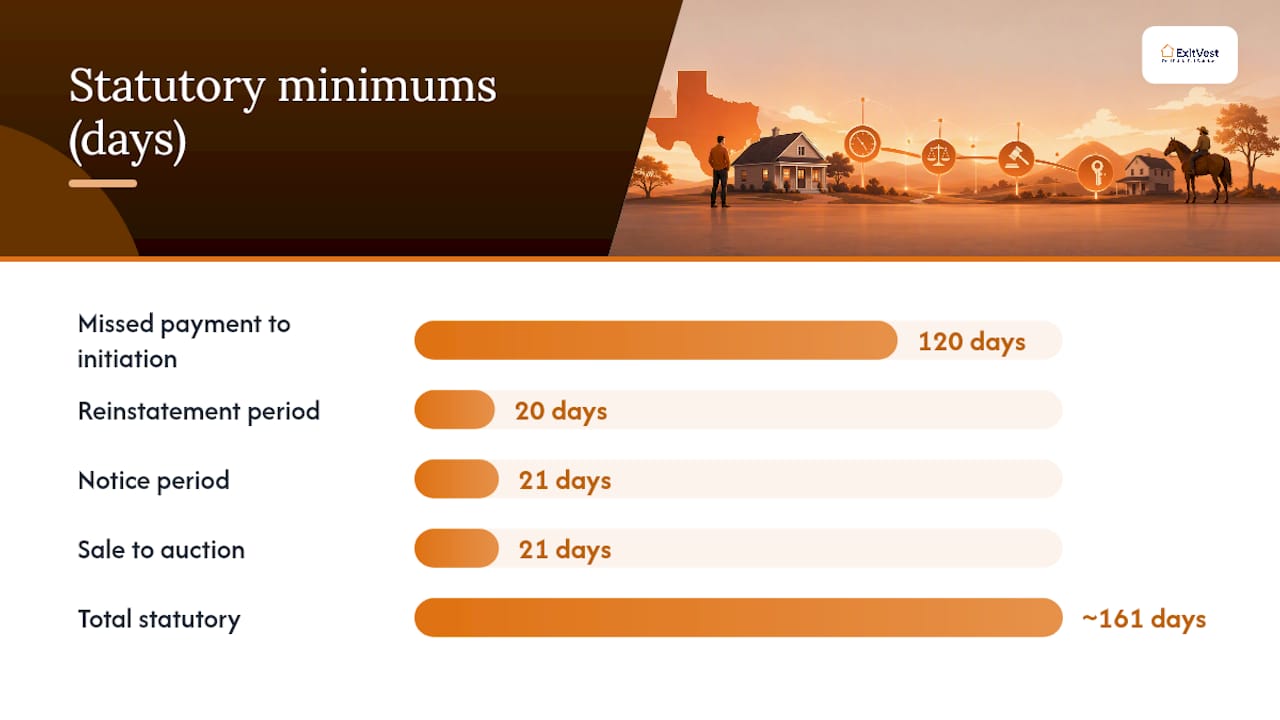
The 6–12 month range reflects real practice: servicers frequently delay notices while reviewing loss mitigation, and administrative steps, holidays, and county scheduling push auctions to the next available first Tuesday.
How to stop or delay foreclosure in Texas
Time is the variable you control most. The earlier you act, the more options you have.
Immediate steps (take these now, regardless of stage)
- Call your servicer. Ask for the exact cure amount in writing, your loan status, and whether a loss mitigation application is pending. Get a name and reference number for every call.
- Gather your documents. Mortgage statement, notice of default, notice of sale (if received), recent pay stubs, bank statements, and tax returns.
- Request a written postponement if your servicer is actively reviewing a loss mitigation application. Under federal rules, servicers generally cannot dual-track (proceed with foreclosure while reviewing a complete application).
- Check your deed of trust for reinstatement rights and any cure periods specific to your loan.
Loss mitigation options, ranked by urgency
- Reinstatement (fastest, cleanest): Pay all arrears, fees, and costs within the 20-day cure period. The foreclosure stops and your loan continues as normal. This requires a lump sum, so act fast if you have access to funds.
- Repayment plan: Spread missed payments over future months. Servicers often prefer this to foreclosure.
- Forbearance: Temporarily pause or reduce payments. Useful for short-term hardship (job loss, medical emergency).
- Loan modification: Permanently change loan terms (rate, term, principal deferral). Takes weeks to months to process; submit a complete application as early as possible.
- Short sale: Sell the home for less than the balance owed, with lender approval. Requires time and lender cooperation, but avoids foreclosure on your record.
- Deed in lieu of foreclosure: Transfer the deed to the lender voluntarily. Faster than foreclosure, but the lender must agree and may still pursue a deficiency.
- Bankruptcy (Chapter 13): Filing triggers an automatic stay that halts foreclosure immediately. Chapter 13 lets you repay arrears over a 3–5 year plan under court supervision, which can save the home if you have steady income. Chapter 7 stops the sale temporarily but does not cure arrears long-term.
TDHCA guidance consistently recommends early, transparent communication with servicers, noting that lenders often prefer options that keep homeowners in their homes. A well-documented, complete loss mitigation application submitted early carries more weight than a last-minute, incomplete one.
Know your rights before you sign anything. The CFPB prohibits mortgage relief companies from charging upfront fees for services they promise to perform. Any company that asks for money before delivering results is a red flag for fraud. Verify any housing counselor through the HUD-approved agency list, and never sign over your deed to a third party without consulting a Texas real estate attorney first.
Pro Tip: Document every contact with your servicer: date, time, representative name, and what was said. If a servicer makes a verbal promise to postpone the sale, follow up immediately with a written request asking them to confirm it in writing. Verbal promises carry no legal weight in a foreclosure proceeding.
What happens at the trustee's sale and after
The auction itself is brief. The trustee reads the notice, opens bidding, and sells to the highest bidder. Third-party investors, the lender itself (taking the property back as REO), or occasionally other parties may bid. Payment is typically required in cash or certified funds the same day.
After the gavel falls:
- The winning bidder receives a trustee's deed, which transfers title.
- The former homeowner has no automatic right to remain. The new owner can begin the eviction process under Texas Property Code Chapter 24, typically serving a 3-day notice to vacate before filing in justice court.
- Eviction proceedings in Texas can move quickly, often resolved within 3–6 weeks from the notice to vacate.
Redemption period in Texas: Unlike many states, Texas does not provide a general statutory right of redemption for homeowners after a non-judicial foreclosure sale. Once the trustee's deed is delivered, the sale is final for most residential mortgages. There are narrow exceptions: certain tax lien foreclosures allow a 2-year redemption period for homesteads, and some HOA foreclosures carry different rules. Home equity loan foreclosures, which must go through judicial process, may also have distinct post-sale rights.
Texas is one of the few states with no general post-sale redemption right for conventional mortgage foreclosures. Once the trustee's sale closes, reclaiming the property requires either proving a procedural defect in court or negotiating directly with the new owner. Neither is easy or guaranteed.
Deficiency judgments: If the sale price is less than the outstanding loan balance, the lender may pursue a deficiency judgment for the difference. Texas law does have some protections here: under the Texas Property Code, the deficiency is calculated against the fair market value of the property, not just the sale price, which can reduce the amount owed. The statute of limitations for a deficiency action is two years from the date of the foreclosure sale under the Texas Civil Practice & Remedies Code.
Key statutes and official resources to check now
Every deadline in the Texas foreclosure process traces back to a specific statute or federal rule. Here is where to find the authoritative text.
The core legal framework:
- Texas Property Code, Chapter 51: Governs non-judicial (power-of-sale) foreclosures. Controls notice requirements, posting and filing rules, sale timing, and trustee duties. This is the primary statute for most Texas residential foreclosures.
- 12 C.F.R. §1024.41 (CFPB/RESPA servicing rule): Sets the 120-day delinquency floor before a servicer may initiate foreclosure and governs loss mitigation procedures, dual-tracking prohibitions, and application review timelines.
- Texas Civil Practice & Remedies Code: Contains the two-year statute of limitations on deficiency judgments after a foreclosure sale.
- Texas Constitution, Article XVI, §50(a)(6): Governs home equity loans and requires judicial foreclosure for that loan type.
How to find county-level notices:
Most Texas counties post trustee sale notices at the courthouse and file them with the county clerk. Many county clerk offices now maintain searchable online databases. Search "[your county] county clerk trustee sale notices" or visit the clerk's office directly. In larger counties like Harris, Dallas, and Travis, online portals are updated regularly.
Official guidance and plain-language help:
- Texas State Law Library foreclosure guides: Step-by-step explanations of the non-judicial process, reinstatement rights, and judicial exceptions.
- TexasLawHelp foreclosure fact sheet: Plain-language summary of the 21-day notice rule, mailing mechanics, and homeowner rights.
- TDHCA foreclosure guidance: State agency resources on loss mitigation and housing counseling.
When time is short: urgent options and how to vet anyone offering help
If the sale date is within 30–60 days, your realistic options narrow fast. Here is how they compare.
| Option | Typical Timeline | Cost/Risk | Certainty |
|---|---|---|---|
| Cash sale (as-is) | 7–21 days to close | Below market price | High — no lender approval needed |
| Chapter 13 bankruptcy | Immediate stay; 3–5 year plan | Attorney fees; credit impact | Moderate — requires feasible repayment plan |
| Contested litigation | Weeks to months | High legal fees | Low — procedural defects are rare |
| Short sale | 30 days | Lender must approve | Moderate — lender can reject |
A cash sale is the fastest path to certainty when the auction is imminent and other options have closed. It won't recover full market value, but it stops the foreclosure, eliminates the deficiency risk, and puts cash in your hands before the sale date. You can learn more about selling a house in foreclosure and what to expect from the process.
Before the sale, gather these documents:
- Most recent mortgage statement showing balance and arrears
- Any Notice of Default or Notice of Sale you've received
- Property tax statements
- Homeowner's insurance declarations page
- Any title or lien documents you have on file
A mortgage document checklist can help you organize what lenders and buyers will ask for.
Pro Tip: Any company offering foreclosure rescue services must provide written terms and a clear fee schedule. The CFPB prohibits upfront fees for mortgage relief services. Verify any housing counselor through HUD's approved agency list at consumerfinance.gov. Require any cash buyer to provide a written offer with a clear purchase price, closing timeline, and no contingencies that let them walk away at the last minute.
What homeowners often miss
The single most common mistake is waiting for a letter that explains everything clearly. Servicers send notices, but those notices are written for compliance, not clarity. Homeowners frequently miss the 20-day reinstatement window not because they lacked the funds, but because they didn't understand the clock had started.
A second pattern: relying on verbal promises. A servicer representative says "we'll put a hold on the sale while we review your application," and the homeowner stops monitoring the county clerk's website. The sale proceeds anyway because the hold was never documented or formally approved.
Habits that materially change outcomes:
- Save every piece of mail related to your mortgage, even envelopes, even notices you don't fully understand
- Log every phone call: date, time, representative name, what was said, and any reference number given
- Request written confirmation of any promise, postponement, or application status within 24 hours of the call
- Check your county clerk's website weekly once you've received a notice of default
- Get the exact cure amount in writing before wiring any funds
The difference between a homeowner who saves their house and one who loses it often comes down to documentation and speed, not money. Someone who calls their servicer on day 30, submits a complete modification application on day 45, and follows up in writing every week is in a fundamentally different position than someone who waits for the situation to resolve itself.
Facing foreclosure? Exitvest offers a fast, straightforward path out
If the sale date is close and traditional options haven't worked, selling your Texas property for cash is often the most reliable way to stop the clock. Exitvest buys houses, land, and small apartment buildings as-is, directly from owners, with no agent commissions, no repair requirements, and flexible closing timelines that can work around your foreclosure date.

To get a fast offer, have your mortgage statement, any Notice of Default or Notice of Sale, and basic property details ready. Exitvest can often move from offer to closing in days, not months, which matters when the first Tuesday of next month is your deadline. The process is straightforward: you describe the property and situation, receive a written cash offer with no hidden fees, and choose a closing date that works for you.
Visit Exitvest's stop-foreclosure page to get started, or see how the process works if you want to understand what to expect before you call.
Sources
- Ecfr
- Foreclosure Fact Sheet | Texas Law Help
- Guides: Foreclosure: Before the Sale - Texas State Law Library
- Statutes
- Texas Department of Housing and Community Affairs foreclosure guidance
Recommended
- Understanding the Foreclosure Process in New Jersey, St.Louis, Florida, Texas, tennessee – CALL <a href="tel:+1-908-913-7526" style="color: #ff5f00">(908) 913-7526</a>
- Foreclosure effects in New Jersey, St.Louis, Florida, Texas, tennessee – what sellers need to know – ExitVest
- Stop Foreclosure in | ExitVest
- How to Stay in My Home After Foreclosure in